Monday, November 21, 2011

Amazon.com

Amazon.com is a leading global internet company. It was founded in 1994 by Jeff Bezos, and was online by 1995. At first, Amazon.com was an online bookstore, although that quickly changed to add music, clothing, computer software, and more, which can hold many times more than what a typical bookstore can hold. The first book to be sold on Amazon, in July 1995, was Fluid Concepts and Creative Analogies: Computer Models of the Fundamental Mechanisms of Thought.

In 1994, Bezos moved to Seattle where he began to work on a business plan that would eventually become Amazon.com. He wrote up a list of twenty products that could be sold on the internet after reading a report projecting the annual web growth at 2300%. He narrowed the list down to CDs, computer hardware, computer software, videos, and books, and finally decided on selling books over the web for three reasons: the large market for literature, the low price that books could be sold at, and the enormous amount of books that were available for print. He chose Seattle to be the location for the headquarters because of its high tech work force and the proximity to a book distribution center. Bezos decided on the name “Amazon” because he wanted it to be one of the first things to appear when listed alphabetically. It is also an “exotic and different” place, as well as one of the largest rivers in the world, something he hoped his company would live up to. They seek to offer the biggest selection and to be the most customer-centric company, where customers can find anything they would want to buy online.
After just four months, it was recognized as the sixth best site on Point Communication's “Top Ten” list and was placed on Yahoo's “what's cool list” and Netscape's “what's new list.” Customers were able to search for an item from the company's homepage they would be shown the desired titles from the company database. However, Amazon.com only had about 2000 titles in its warehouse. Most of the orders were placed through wholesalers and publishers, diminishing the need for a warehouse. Initially, Amazon.com was run in Bezos' garage, until it started growing, making it necessary to move to an office in Seattle. This office was also used as the customer support, shipping, and receiving area. Within a month of launching the website, orders from all 50 states as well as 45 other countries had been filled.
One of Bezos' goals for Amazon.com was to set the standard for web businesses, leading to him making the website as customer friendly as possible. It offered customers powerful search capabilities of its expanded 1.5 million title database. They also started offering discounts, making the books even more affordable. The option to browse different topics was also made available to customers, as well as more specific areas, such as best-sellers and award winners. Recommendations were another addition to the site, based on previously purchased books by the customer.
By May 1997, Amazon.com was a public company with an IPO (initial public offering) of three million shares of common stock. Bezos began improving the website further with the proceeds from the IPO. In September 1997, an East Coast distribution center was opened in order to lessen the strain on the one in Seattle and to help broaden the company's distribution capabilities. The Seattle center was also majorly expanded. These efforts reduced the time it took to fill orders. In July 1996, Amazon.com established the “Associates” program, which allowed people with their own websites to place ads for books on their sites. By mid-1997, Amazon.com created partnerships with Yahoo, Inc. and America Online, two of the most visited sites, who gave Amazon.com broad promotional capabilities of their sites, thus really launching the Associates program. Around this time was also when Amazon.com became the first online retailer to reach one million customers in all 50 states and 160 countries around the world. In 1998, Amazon.com Advantage, which helped the sales of independent authors and publishers, and Amazon.com Kids, which provided thousands of titles for younger readers, were added. They also expanded into Europe. IMD (the Internet Movie Database) was used to support plans for its move into online video sales. Another huge improvement was the introduction to the online music business. The music store was opened in 1998, offering over 125,000 music titles.
Online auction services were introduced in 1999, as were the sales of toys and electronics. Around that holiday season, sales reached $1.6 billion. This was also the year that Bezos was named Time magazine's “Person of the Year.” In 2001 however, Amazon.com laid off 1300 employees and closed a distribution facility in order to cut costs. This was also around the time that other retailers, such as Borders and Toys R Us, were selling products through Amazon.com.

Amazon Simple Storage Service (Amazon S3) was launched in 2006, allowing people to store up to 5 terabytes of data, as was Amazon Simple Queue Service (a distributed queue messaging service) and Amazon Elastic Compute Cloud (a virtual site farm). Amazon Prime was offered starting in 2005 in the US, 2007 in Japan, the United Kingdom, Germany, and France, which offers two day shipping with no extra charge, and access to instant streaming of movies and TV shows as of November 2011.

Due to the extremely high traffic, especially during the holiday season, Amazon.com has invested on a massive amount of server capacity. As of 2008, amazon.com had more than 615 million visitors annually, nearly twice as many as others such as walmart.com. Customers can now submit reviews for each product. They can also search for key words within the text of certain books, but can only show that section of the book due to copyright policies.

Amazon.com has dealt, and is dealing, with many controversies, including health issues, bad warehouse conditions for workers, sales tax, price discrimination, and censorship of certain content. There has also been a lot of controversy with their “One Click” check-out patent, which was issued to them in 1999. In 2000, they licensed One Click check-out to Apple Computer. However, they filed a lawsuit against Barnes & Noble for using the One Click method. Barnes & Noble had to stop offering what they called “Express Lane,” and required customers to have to click twice in order to confirm their orders.

As of 2011, there are about 137 million active customers worldwide. North America representing 55.4% of sales, and the other 44.6% in the International market. They were one of the first to sell products in the “long-tail” because they store them in warehouses and distribute from partner companies. They also released a Mac download store, offering many pieces of software for Apple Computers.
We have all used Amazon.com. It is an extremely convenient and easy form of shopping for just about any item available, whether to find books for school, a gift for a friend or family member, or a simple household object. It lets customers to quickly search for an item and then returns a long list of items that may relate to the key words entered, ranging in prices and quality. This process is made even simpler by the use of one click check-out, allowing people to reduce the time it takes to go through the check-out process.
References:
http://www.crunchbase.com/company/amazon
http://www.essortment.com/history-amazoncom-21180.html
http://www.fundinguniverse.com/company-histories/Amazoncom-Inc-Company-History.html
http://en.wikipedia.org/wiki/Amazon.com
http://jobsearchtech.about.com/od/companyprofiles/a/Amazon.htm
The Mobile Web: Past, Present, and Future
From the birth of the internet to present day, society has been transformed by its capabilities and the technologies that utilize it. The internet has provided a new way of sharing information, communicating with others, and promoting businesses. To further engrain the internet into today’s culture, the mobile web has compact its capabilities into a hand-held device, allowing for on-the-go, instant access to the web. The mobile web has become ubiquitous to everyday living.
The First Mobile Internet Phone
 Before the smartphone craze, the mobile web began off to a slow start with the first mobile internet phone. It was 1997 when carrier, AT&T, put out the first mobile internet phone. It had a 19.2 kbps modem, was part of AT&T’s Cellular Digital Packet Data (CDPD) network, and was called PocketNet by Pacific Communications Sciences Inc. To their disappointment, the PocketNet only sold around 20,000 units. Its adaption in the market was not a success. This was most likely a consequence of the device’s poorly designed features and limited capabilities. The LCD screen’s three line and sixty character limitation reduced readability and induced excessive scrolling. The phone also had low appeal to customers since most websites were not compatible and could not be viewed. In addition, users could not make calls while the phone was set in data mode. Therefore, in the consumers’ eyes, the phone did not have much to offer. However, it did provide AT&T a head start, building a team ready to venture into an open market. It served as a transition for mobile phone service providers to offer both voice and data services.
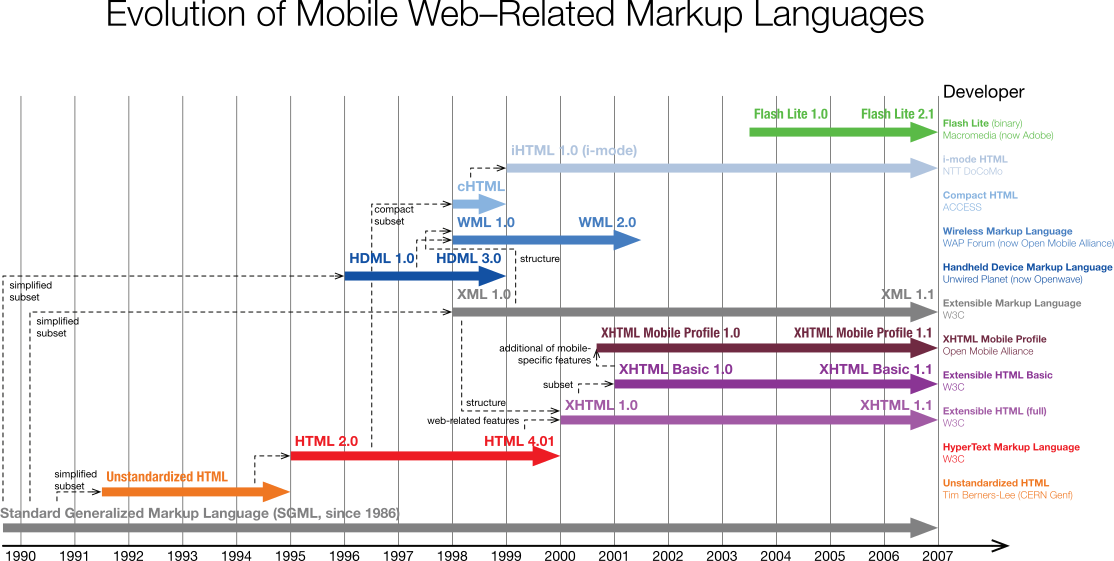
After the release of the PocketNet, AT&T continued to develop and push improved internet phones into the market. AT&T’s mobile phones were powered by technology from Unwired Planet, otherwise known today as Openwave. The protocol used was Handheld Device Transport Protocol (HDTP) and Handheld Device Markup Language (HDML), and later Wireless Application Protocol (WAP) and Wireless Markup Language (WML) was adopted. These standards differed from computer internet which uses HTTP and HTML. This difference causes sites that were to be viewed on the computer to be incompatible for mobile viewing. Although, Openwave justified the use of different protocols, claiming that they were required due to the limitations of mobile devices and network. However, an underlying motivation most likely stemmed from the revenue gained by selling WAP gateways to carrier companies like AT&T, which were to bridge IP-based internet networks and mobile networks.
Ahead of the Curve
 Japan, on the other hand, disproved this notion with their first mobile internet service called i-mode. It was launched in 1999 by Japan’s largest wireless provider, NTT DOCOMO. Unlike AT&T’s releases, DOCOMO’s was a success, reaching ten million customers after a year of release and more than forty million by 2003. Some say the overnight success was due to Japanese culture being that the Japanese are early adapters of technology, have dense cities that favor mobile communication, and have higher landline internet costs. These factors are supplemental to DOCOMO’s success but the real reasons are attributed to the company’s understanding of what appeals to users and providing that at an agreeable price. The company set their goals on providing useful content to their customers, charging for the data plan and keeping basic apps free. DOCOMO’s model gave content providers incentive to work with them, giving 91% of the revenue gained from the content sales to the provider. Their model also lessened the obstacles developers faced when developing and testing for mobile phones. When the rest of the world was developing with WAP/WML and HDTP/HDML, DOCOMO realized the challenge those protocols created for developers and the extra cost for its use. Therefore, DOCOMO used iHTML which is a compact version of HTML. As a result, developers did not have to acquire new languages and could utilize developing and testing environments for mobile web applications. This new model promoted a cycle of growth, motivating content providers and developers to create and customers to consume.
Leader of the Pack
Back in the United States, mobile web was slow to take off. Signs of the public warming up to the idea of the mobile web soon emerged with simpler services like SMS and downloads for digital content like ringtones. Then in 2001, xHTML Mobile Profile 1.0 was released, but upon release, mobile phones still could not support the color and presentation to display websites yet. The market lacked a phone that would satisfy user expectations for viewing the web on a mobile device. It was not until June of 2007 that Apple’s iPhone not only satisfied but went beyond those requirements.
Among the many features of the iPhone, its captivating 3.5 inch color touchscreen display with accelerometer and proximity sensors is one of the many that provide users the experience they desire for surfing the web. The Apple device caused an explosion in the market for mobile devices, skyrocketing AT&T’s data usage growth due to their exclusive deal with Apple’s iPhone. The success can be attributed to Apple’s model; like DOCOMO’s model, Apple concentrated on developers and users, aligning computer internet with mobile and designing the iPhone for usability.
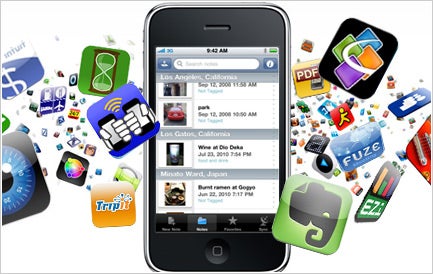
The use of the mobile web took leaps beyond SMS and simple downloads. With the iPhone came sophisticated mobile applications that supported games, news, social networks, location-based tools, etc. Competitors soon followed with their own line of smartphones and app markets. Apple leads the app market with competitors such as BlackBerry, Nokia, and Google trailing behind, selling a combine total of over two billion apps last year.
For a Brighter Future
Mobile web apps are growing quickly today. However, for the future of the mobile web, much can be improved. Apple’s dominance in the market has caused concern for excessive dictation for how apps should be developed and what apps should be developed. App development should move towards developing across devices, not for specific devices. There should be a broader distribution for apps because Apple’s products are not a business model but merely a medium to reach customers.
The mobile web should promote open innovation. This includes making sure flash sites are not disregarded. Approvals for apps should be less restricting, and the revenue split between Apple and the developers should favor developers more. Following innovations in the computer world, the mobile web should better utilize cloud computing in order to share resources and access information and software from any device.
The future for the mobile web also entails moving beyond the idea that the mobile web is for the smartphone. The mobile web should be thought of as meaning connection everywhere and anywhere. The mobile web is not just a hand-held device, but it can be technology in a car, living room, academic building, etc. It is also not just accessed through a touchsceen. All interactions such as voice and the movements of the physical body are ways to interact with it, making the future of the mobile web truly ubiquitous.
Resources:
http://openattitude.com/2010/03/01/the-history-and-future-of-the-mobile-web/
http://www.bothsidesofthetable.com/2010/02/17/app-is-crap-why-apple-is-bad-for-your-health/
Online Advertising: Because It’s Worth It
Although online advertising has only existed for a short couple of decades, its growth has been exponential, and its presence has had a most significant effect on both the corporate world and its extensive commercial audience. While the industry attracts both admirers and critics, its general success and pervasiveness are undeniable. The following article will explore the captivating history of online advertising by discussing its many forms, analyzing its advantages and disadvantages. It will then justify its overall efficacy with specific case studies, particularly the model achievements of Google.
What is Online Advertising?
Before getting started, it is perhaps best to first define “online advertising,” for it is a broad term that takes on a variety of meanings and forms. Generally, when one mentions online advertising, one refers to the promotion of a good or service via the Internet and World Wide Web. However, one could specifically mean a variety of things, for there are several different types of online advertisements, many with unique characteristics and goals.
Visually, the most basic kinds of advertisements are text, display, and rich media. One of the most popular kinds of text advertisements is the e-mail ad. The first e-mail ad was created in 1978 by Gary Thuerk of the Digital Equipment Corporation, and was sent via ARPANET to announce a new DEC computer system. Although it was not intended to be an advertisement, per se, it marked the beginning of commercial spam, which in turn has begot the legitimate form of e-mail advertisement in which companies send messages to customers in an effort to build customer loyalty and expand their consumer base. Other simple text ads appear as links within the written content of a website. One of the first display ads was released in 1994 by AT&T and was published on Hotwired.com in the form of a banner ad. That same year Club Med, Volvo, and MCI created banners for Hotwired as well, marking the beginning of the banner ad boom. After the introduction of the banner ad, a multitude of new display ads took form. Some examples are: pop-up/under ads, which are displayed in a new window in front of or behind the current one being viewed; floating ads, which move across the computer screen; and wallpaper ads, which transform the background of a site into ad space. Rich media ads, which can shrink/expand, include high quality video, images, text, or other interactive aspects are the newest form of online advertisements. Their popularity is growing quickly for their appearances and interactivity are evolving each day.
These categories can be further divided into the following groups based on the specific type of site on which they are displayed: search engine, social media, mobile, and classifieds. Search engine ads (which will be discussed in greater depth towards the end of this article) allow businesses to pay for greater visibility or higher ranking on search engine sites; they are text ads, and one of the most popular fiscal models is pay-per-click, which requires advertisers to pay the site owner each time their advertisement is clicked. Social media ads which allow advertisers to create Facebook or Twitter pages with which customers can interact increase awareness and in theory expand their customer base by allowing people to rate, “like,” “friend,” or “follow” their business. Mobile ads take a variety of forms, but are usually some sort of graphic display ad; like social media ads, they are a relatively new form of promotion but continue to rapidly grow. Classified ads, much like those traditionally found in newspapers, became particularly popular after the launch of Craigslist in 1995. This format allows advertisers to promote and sell just about any kind of product, from housing, to jobs, to résumés, personals, and more traditional items.
What is Online Advertising?
Before getting started, it is perhaps best to first define “online advertising,” for it is a broad term that takes on a variety of meanings and forms. Generally, when one mentions online advertising, one refers to the promotion of a good or service via the Internet and World Wide Web. However, one could specifically mean a variety of things, for there are several different types of online advertisements, many with unique characteristics and goals.
Visually, the most basic kinds of advertisements are text, display, and rich media. One of the most popular kinds of text advertisements is the e-mail ad. The first e-mail ad was created in 1978 by Gary Thuerk of the Digital Equipment Corporation, and was sent via ARPANET to announce a new DEC computer system. Although it was not intended to be an advertisement, per se, it marked the beginning of commercial spam, which in turn has begot the legitimate form of e-mail advertisement in which companies send messages to customers in an effort to build customer loyalty and expand their consumer base. Other simple text ads appear as links within the written content of a website. One of the first display ads was released in 1994 by AT&T and was published on Hotwired.com in the form of a banner ad. That same year Club Med, Volvo, and MCI created banners for Hotwired as well, marking the beginning of the banner ad boom. After the introduction of the banner ad, a multitude of new display ads took form. Some examples are: pop-up/under ads, which are displayed in a new window in front of or behind the current one being viewed; floating ads, which move across the computer screen; and wallpaper ads, which transform the background of a site into ad space. Rich media ads, which can shrink/expand, include high quality video, images, text, or other interactive aspects are the newest form of online advertisements. Their popularity is growing quickly for their appearances and interactivity are evolving each day.
These categories can be further divided into the following groups based on the specific type of site on which they are displayed: search engine, social media, mobile, and classifieds. Search engine ads (which will be discussed in greater depth towards the end of this article) allow businesses to pay for greater visibility or higher ranking on search engine sites; they are text ads, and one of the most popular fiscal models is pay-per-click, which requires advertisers to pay the site owner each time their advertisement is clicked. Social media ads which allow advertisers to create Facebook or Twitter pages with which customers can interact increase awareness and in theory expand their customer base by allowing people to rate, “like,” “friend,” or “follow” their business. Mobile ads take a variety of forms, but are usually some sort of graphic display ad; like social media ads, they are a relatively new form of promotion but continue to rapidly grow. Classified ads, much like those traditionally found in newspapers, became particularly popular after the launch of Craigslist in 1995. This format allows advertisers to promote and sell just about any kind of product, from housing, to jobs, to résumés, personals, and more traditional items.


Given the aforementioned definition of online advertising, it is perhaps best to now analyze its general efficacy; with particular emphasis on its advantages over traditional advertising methods.
The Online Advantage
While all advertising mediums have their advantages and disadvantages, the online advertisement industry has some truly unique benefits that are especially advantageous in today’s dynamic marketplace because people are increasingly spending more and more time on the Internet. The success may not be evenly distributed among the many different types of online advertisements, but in general online advertising has become a billion dollar industry that continues to rapidly grow.
One of the biggest advantages of online advertising is its accessibility; advertisers can easily and instantly introduce their products to billions of people around the globe, and their advertisements are accessible to customers every day, (essentially) all of the time. Additionally, many types of online advertisements are easily modified; this is particularly helpful if a company notices its current ad has a low response rate because they can simply adjust their ad’s display and try again. Another advantage is that online advertisements are extremely targeted; and likewise, the programs used to market a specific audience, like AdWords and AdSense by Google, are relatively inexpensive in comparison to methods used by newspaper companies and other advertising mediums. Possibly the greatest advantage of online advertising is its efficient and effective ability to track the success of an ad. For example, it is simple for a company to measure the number of people who view their ad, the number of times their ad is clicked, or the number of times a person views their ad and continues on to view the company’s website. This kind of tracking is incredibly difficult to achieve, if not impossible, with any kind of advertising other than online.
The economic advantages of online advertisement vary substantially among the different types of web advertisements available. However, there are a couple of benefits that they all share. Firstly, the overall cost of an online advertisement is likely to be less expensive than that of alternative print mediums which often require printing and reprinting, distribution and redistribution, and can have expensive start-up costs. Secondly, the sophisticated tracking methods mentioned above allow advertisers to more easily measure the efficacy of their advertisements, can keep them from investing further into an unsuccessful ad, and thus save them money.
One of the most profitable online advertising companies is Google. It has not only earned billions of dollars in revenue by selling its advertising space and programs, but has set the standard for all online companies that wish to create successful and lucrative promotional campaigns.
Google: A Model of Success
In the late 1990s the banner ad boom was in full swing, and online companies were investing (and planning to invest) vast sums of money into online promotional campaigns. However, when the online advertising bubble burst in the spring of 2000, the online market, in particular the banner market, took a substantial hit. With advertisers’ faith in online investment now wavering, the future of online advertising was uncertain.
However, the market crash did not have a significant effect on search-based websites, particularly Google. This is because rather than investing in banner ads during the boom, Google had been focusing on text-ads that were based on search engine results and placed above or adjacent to them. This advertising method proved to be hugely profitable and propelled Google to become one of the most profitable, if not the most profitable online adverting company in the world.

Although Google adopted some of its techniques from other search-engine companies, the key to its success was relevance, which made the ads promoted on Google immensely profitable. The program introduced by Google in 2000 was called AdWords and used a self-serve pay-per-click standard. While it was lucrative, it was reshaped in 2002 to model a program created by Overture which used an auction-based pay-per-click model. While the new framework for AdWords was more or less borrowed, the quality that set Google apart from Overture and all other competition at the time was its sophisticated ranking algorithm. The algorithm assured that sites could not simply bid their way to the top of Google’s search pages, but had to be relevant to the search terms (had to have high click-response rates) in order to be highly ranked.
The graph below proves that Google’s model has been incredibly profitable. Its profitability, in turn, has also set a higher standard for all other advertising companies. While some seek to be more like Google, others simply wish to beat it out. For example, in November 2011 Microsoft, Yahoo, and AOL announced that they are going to form a partnership to sell online advertisement. They believe that by joining forces they can outsell both Google and Facebook. With such high profits and stimulating competition generated by the search-engine industry, it seems that search-engine advertisements will keep the online advertising industry alive for many years to come.

Sources:
·
http://email.about.com/od/emailtrivia/f/first_spam.htm
·
http://www.cctadvertising.com/beyond-banners/
·
http://publishing2.com/2008/05/27/google-adwords-a-brief-history-of-online-advertising-innovation/
·
http://www.washingtonpost.com/business/technology/microsoft-yahoo-aol-form-partnership-to-sell-online-advertising-in-attack-on-google/2011/11/08/gIQA21xZ2M_story.html
·
http://www.ogilvydma.com/2011/06/8-types-of-online-ads/
·
http://www.impliedbydesign.com/articles/the-advantages-of-internet-advertising-vs-traditional-advertising.html
·
http://www.1stwebdesigner.com/design/online-advertising-history/
·
http://googleblog.blogspot.com/2009/04/whats-rich-media-ad-anyway.html
·
http://www.adweek.com/adfreak/looking-back-first-banner-ad-maybe-19834
Images:
·
http://editorial.designtaxi.com/news-golden1811/2.png

·
http://searchenginewatch.com/article/2112920/Search-Advertising-Revenues-Hit-7.3-Billion-in-First-Half-of-2011-Report
·
http://www.onlinemarketing-trends.com/2011/01/online-marketing-evolution-infographic.html
·
http://www.1stwebdesigner.com/design/online-advertising-history/
·
http://googinvestor.blogspot.com/2011/10/google-reports-record-earnings-charts.html
·
http://www.marketingcharts.com/interactive/online-ad-revenue-yahoo-yearns-as-google-grows-1013/emarketer-us-online-ad-revenue-share-google-yahoojpg/
·
http://articles.businessinsider.com/2011-09-08/tech/30154897_1_facebook-yahoo-twitter
·
http://searchenginewatch.com/article/2112920/Search-Advertising-Revenues-Hit-7.3-Billion-in-First-Half-of-2011-Report
Skype

To start off with a formal definition…
Skype is a software application that allows users to make voice and video calls and chat over the Internet.
Most 21st century interwebbers are familiar with Skype. People use Skype to voice or video chat with friends and family. Instead of using the traditional form of telephoning a friend or a family member, people can video call anyone they want with Skype. Distance doesn’t matter either. Anyone with Internet connection and Skype installed on their computer can chat and make calls. Any Skype user can make video calls and phone calls to other Skype users for free. Calls to landline telephones and mobile telephones can be made for a fee using a debit-based user account system. Following the trend of growing smartphone users, Skype also introduced mobile versions of the software to allow more users to use their program on their personal mobile devices. Even job interviews are carried out through Skype now.
Since its birth, Skype has grown to become the largest international voice carrier, garnering over 663 million registered users as of September 2011. As of 2010, Skype was available in 27 languages and had an average of over 100 million active users each month.
This video describes how Skype works
History
So let’s go back in time and take a look at how Skype started. Skype was founded in 2003 by Janus Friis from Denmark and Niklas Zennstrom from Sweden. The creators of Skype first met each other at Tele2, a Swedish telecom company where they were both employed. In 1999, they put in their resignations and decided to form a development team. Before Skype was released in 2003, both Zennstrom and Friis had already earned a name for themselves in 2001 for creating a popular file sharing software called Kazaa, which is one of the world's most downloaded programs. Kazaa is a peer-to-peer file sharing software. The Skype software was developed by the brains behind Kazaa, Estonians Ahti Heinla, Priit Kasesalu, and Jaan Tallinn. The creators of Skype developed the program to offer a way of making local and international telephone calls in the IM environment.
When Skype was first launched as beta in August 2003, it was only available on the Windows platform. Its initial features included voice calls (VoIP) and chat features, and video call functionality was later added in December 2005. In April 2006, the number of registered Skype users reached 100 million. In October 2006, Skype for Mac was first released to the public. Skype for Linux was launched in March 2008, which also supported video conferencing features. Throughout 2007, updated added many new features such as: Skype Find, Skype Prime, Send Money, video in mood, inclusion of video content in chat, call transfer to another person or a group, and auto-redial.
China banned Skype in September 2005. In October 2008, however, analysis revealed TOM-skype – the Chinese version of Skype run by TOM online – sends content of text messages and encryption keys to monitoring servers. Since September 2007, users in China trying to download the Skype software client have been redirected to the site of TOM online, a joint venture between a Chinese wireless operator and Skype, from which a modified Chinese version can be downloaded.
Growth
Skype has experienced rapid growth in both popular usage and software development since launch, both of its free and its paid services. The Skype communications system is notable for its broad range of features, including free voice and video conferencing, and its ability to use peer to peer (decentralized) technology to overcome common firewall and NAT problems.
Skype Usage and Traffic Chart
* Skype users may have more than one account; it is not possible to count users, only accounts.
| Date | Total user accounts | Active users, daily use | Skype to Skype minutes | SkypeOut minutes | Revenue USD |
| Q4 2005 | 74.7 | 10.8 | N/A | N/A | N/A |
| Q1 2006 | 94.6 | 15.2 | 6.9 | 0.7 | 35 |
| Q2 2006 | 113.1 | 16.6 | 7.1 | 0.8 | 44 |
| Q3 2006 | 135.9 | 18.7 | 6.6 | 1.1 | 50 |
| Q4 2006 | 171.2 | 21.2 | 7.6 | 1.5 | 66 |
| Q1 2007 | 195.5 | 23.2 | 7.7 | 1.3 | 79 |
| Q2 2007 | 219.6 | 23.9 | 7.1 | 1.3 | 90 |
| Q3 2007 | 245.7 | 24.2 | 6.1 | 1.4 | 98 |
| Q4 2007 | 276.3 | 27.0 | 11.9 | 1.6 | 115 |
| Q1 2008 | 309.3 | 31.3 | 14.2 | 1.7 | 126 |
| Q2 2008 | 338.2 | 32.0 | 14.8 | 1.9 | 136 |
| Q3 2008 | 370 | 33.7 | 16.0 | 2.2 | 143 |
| Q4 2008 | 405 | 36.5 | 20.5 | 2.6 | 145 |
| Q1 2009 | 443 | 42.2 | 23.6 | 2.9 | 153 |
| Q2 2009 | 483 | ? | 25.5 | 3.0 | 170 |
| Q3 2009 | 521 | ? | 27.7 | 3.1 | 185 |
| Q4 2009 | ? | ? | 36.1 | ? | ? |
| 2010 (full year) | ? | ? | 190 | 12.8 | 860 |
Acquisitions
eBay acquired Skype Limited in September 2005 and in April 2009, eBay announced plans to spin it off in a 2010 initial public offering. It was acquired by Silver Lake Partners in 2009. On May 2011, Microsoft agreed to purchase Skype for US$8.5 billion, and the company is to be incorporated as a division of Microsoft called Microsoft Skype Division. Microsoft acquired all of the company's technologies with the purchase. This was completed on 13 October 2011.
Competition
Many chat platforms and other competitive chat applications have introduced video call features over time.
Apple introduced FaceTime, a video calling software that launched with the iPhone 4. Since its launch, FaceTime is now available for the Mac operating system as well, allowing Apple devices with front-facing camera to FaceTime with other Mac OS users. FaceTime has the potential to quickly gain users through its Mac OS and iOS users.
Google Talk (also known as Google Chat), a free VoIP application developed by Google, also added video call functionalities to its application. Google Talk has a significant advantage over Skype since any Google account user can use Google Talk without having to sign up for a new account. As more and more Google account users start using Google Talk, more people will be exposed to Google Talk’s video chat functionality. These users will likely use Google Talk over Skype, since they don’t have to open up and login to a separate program for chatting.
Facebook Chat also added video chat capabilities in August 2011. As one of the leaders in social networking service, Facebook’s video chat capabilities can easily threaten Skype with its millions of active users. Similar to Google Talk, Facebook already has many active users who will choose to use Facebook Chat’s chat functionalities, as opposed to opening up program.
ooVoo, which is a instant messaging client, is known for getting the notion of video conferencing popular in the earlier days. Founded in 2007, ooVoo rivaled Skype in the earlier days. Skype, however, had more competitive advantage than ooVoo. Skype was introduced earlier, and had many other functionalities and ooVoo had to catch up to.
Other popular instant messaging (IM) services have added video chat capabilities to allow their users to connect with others in a more interactive way. Popular messengers such as Yahoo! Messenger, Windows Live Messenger, AIM have all incorporated video calling features to their platform. Meebo, a browser based IM program which supports multiple IM services as well its own, has allowed users to video chat with the IM service of their choice. This functionality allows users to access any of the IM services that Meebo offers, and enjoy similar features as Skype.
Future of Skype
Skype has been constantly introducing new features to maintain its competitive edge. It has increased the number of platforms it is available on, and has been making mobile versions of the program to expand the usage of the program. It has added SMS features, which allows users to send text messages. In October 2011, Skype introduced Facebook integration, which will allow users to connect their account to their Facebook account. Skype users can make free voice and video calls to their Facebook friends, as well as sending instant messages without having to leave the Skype program. This flexibility will help users to keep using Skype as their primary IM service.
Video on Sending SMS through Skype
Video on Skype and Facebook Integration
Conclusion
The methods of communication have changed over time, and the Internet has pushed our generation into new ways of communication and interaction. VoIP applications, such as Skype, have certainly changed how we communicate. Just as how the ways of communication evolved over time, Skype is evolving to tailor their services to the users’ needs. With updates and new versions that add more features, Skype tries to empower their users with more options and hopes to gain new users in the process as well. Even with many rising competitors in the IM and VoIP industries, Skype is performing very well to stand as the largest international voice carrier. What Skype will bring in the future is a mystery, but I personally hope for Skype to generate creative and innovative ideas to stay on top of its competition.
Sources
2. http://en.wikipedia.org/wiki/Skype
3. http://en.wikipedia.org/wiki/Skype_Limited#History
4. http://www.youtube.com/user/skype?blend=7&ob=5
5. http://en.wikipedia.org/wiki/Facetime
6. http://en.wikipedia.org/wiki/Google_talk
7. http://en.wikipedia.org/wiki/Facebook_chat#Chat
Subscribe to:
Posts (Atom)