Sunday, December 11, 2011

Building Civilization

The World Wide Web is arguably the greatest medium of communication humanity has ever developed; however, is there any great communication going on? Beyond games, shopping, dating, etc., behind mass advertising and revenue maximizing exists an Internet with a more remarkable purpose.

Ubiquity of the Internet in Education

At the turn of the millennium, nearly 95% of youths reported using the Internet for school research; over two thirds used the Internet as their primary source for material. And these numbers are only getting larger. Now, ten years later, this trend has seemed to come of age, and the impact of the Internet on education is undeniable. Seemingly far removed from its origins as an inter-university network, the world wide web can be considered to be returning to its roots. Higher education has finally caught up to and embraced the ubiquity of the internet. It now seems like a far stretch from the 2001 finding that only about half of students had used a Website specifically set up for a particular class. Now, students will be hard pressed to avoid one.

Higher Education Online

The importance of the Internet in higher education is undeniable, not only in helping supplement available material, but also in substituting for it. Online databases such as JSTOR provides thousands of scholarly articles for academics and students conducting research for projects or papers. This free resource, available to most students in higher education represents the universal acknowledgment of the value of sharing information in education. Such free and reliable information sharing is invaluable to the goal of higher education. However, in the last decade, the internet redefined higher education in an entirely different and equally substantial way. One of the most prominent of these resources, released in 2007 by Apple is iTunes U. Expanding the media sharing model to beyond internal networks, Apple’s iTunes U provides universities with the infrastructure to share content with the entire world. Currently, nearly 400 world class universities distribute course content publicly on iTunes U. Whether one wishes to download lectures on psychology from Cornell or brain imaging from Carnegie Mellon University, iTunes U provides university level content available to anybody anywhere.


Expanding the Model

Such innovations are not, however, limited to higher education. In 2006, MIT graduate Salman Khan began his mission to of providing free educational videos directed for students from kindergarten to 12th grade, covering mathematics, sciences, and the humanities. Now five years later, the Khan academy has over 2700 instructional videos accessed over 90 millions times. The Khan Academy’s goal is to provide “free world-class education to anyone anywhere.” The Academy uses a ground breaking approach that combines intuitive subject building and extensive data collection to track student progress and apprehension. The mechanics of the curriculum focuses on acknowledging actual progress as well as providing a big picture of what the student is learning.

The Khan Academy is not the only example of free, open source education available. Another service, Open Culture, founded in 2006, seeks to provide “high-quality cultural and educational media for the worldwide lifelong learning community.” Open Culture provides free audiobooks, online course, movies, language lessons, and ebooks. Whether one wants to watch A Fistful of Dollars, find an introductory German lesson, or take a course on Ancient Greek History, Open Culture provides the resources to do so all for free and all easily accessed online.


Redefining Literacy

While online education has been breaking out in many new and innovative paths, so too have some of the most fundamental mediums through the world wide web. As a mechanism for the dissemination of knowledge, printed text is still an important resource. However, one of the most common problems with printed media is their difficulty of access. The service reCaptcha seeks to change this in an innovated and convenient manner. reCaptcha is a version of the Captcha programs meant to distinguish human users from computer generated responses used to ensure security and authenticity. The purpose of reCaptcha is to take that mundane authentication and verification task and turn it into useful computer power. This system works by asking the user to translate scanned text from books into normal text. Since this task is inherently difficult for computers, the human brain is much more efficient. The goal of the reCaptcha is to develop a system for helping to translate many copies of books that still exist only in print format into computer-understandable text. These texts thus become catalogue-able and searchable through services such as Project Guttenberg and Google Books. This project represents yet another example of how the world wide web is helping to revolutionize how learning and education occurs in modern culture.

Yet another example similar to reCaptcha is Duolingo. Here, instead of translating print media into text, however, Duolingo’s purpose is to translate between different language. Currently, the internet has a great deal of diverse content from many different languages, but often each source is not available in any language other than its original content. Duolingo seeks to change this by gathering the effort of the human intelligence and problem solving. Structured as a language course for people who want to learn a new language, Duolingo works by crowd sourcing translations amongst the participants. Its goal is that through the cumulative efforts of these students, the vast majority of online content can be made readily available for many more languages other than their original one.


From the Ground Up

More recently, projects have begun to focus on even more rudimentary but equally vital subjects. One particular example is the Global Village Construction Set from Open Source Ecology. The Global Village Construction Set project seeks to provide free blueprints for the forty machines necessary to build a self-sustaining civilization from the ground up. Machines such as tractors, drills, and brick makers are made from easy to follow designs that can be made on limited resources. By making these blueprints free and openly available, to project hopes to give smaller, developing economies more economic and financial stability and independence while also reducing material waste.


Where Can We Go From Here?

In the last fifty years, the internet has managed to revolutionize more about our society than arguably any other invention of our time. With it has come the revolution of countless methods and products of day to day livelihood, from communication to commerce to politics. While each instance is an important part of life in the twenty first century, it seems as though its full potential has only begun to present itself. No longer is the World Wide Web a thing of frivolity or novelty. It is, very fittingly, a way of life. Thus, it seems necessary that in this new way of life some of our most basic, yet most important institutions progress along side it. Fortunately, if anything, our society has demonstrated its willingness to adapt and adopt this new medium in some of its most important contexts. The restricting of the educational model to focus on convenience, accessibility, interactivity, and portability Only now in its relative infancy the possibilities are near limitless. Online education provides a model for infinitely scalable and accessible education to millions if not billions of people who would have never had such an opportunity. While we are a ways away from fully supplanting a traditional education, we are certainly at the point of bolstering the ability of a community from the ground up, from tilling the land to lessons on advanced organic chemistry.


Works Cited:

"The Internet and Education: Findings of the Pew Internet & American Life Project" Pew Internet & American Life Project.

iTunes U. Apple Inc.

JSTOR. "About."

Khan Academy. "About."

Open Culture. "FAQ"

Duolingo.

"Digitizing Books One Word at a Time." reCaptcha.

Open Source Equality.


Thursday, December 8, 2011

Peer to Peer File Sharing

Peer- to- peer file sharing, also known as P2P or in colloquial terms “torrenting”, is something that allows users to download media files ranging from movies to music and to games. This is done by using a P2P software client that has the capability to search for other computers that are connected as well. These connected computers are known as “peers”, which are computer systems that are associated with one another via the Internet. The requirements that a computer needs to join this peer- to –peer set of connections are P2P software and an Internet connection.

The history of the P2P software dates back to the first generation software in 1999, called Napster. Although Napster was eventually shut down, the purpose of it was to be a file sharing program and central server that linked people with files to other people who requested those certain files. The central index server was meant to index all of the current users and search their computers for those particular files. How this worked was when one person searched for a specific file, the server would search for all of the available copies of that file and present them to the user. After this, the files would be transferred between the two users. The main drawback of this was that the files being shared were limited to only music. Since this process occurred on a central server is, Napster was held responsible for copyright infringement and was officially shut down in July of 2001. Then second generation of the P2P software is Gnutella and Kazaa, both user- based models that tried to replicate Napster in creating new ways of sharing files, but not infringe copyright laws. The difference between these services and Napster was that they connected users remotely to each other and allowed users to download files that were only limited to music, but also movies and games. Finally, the third generation that emerged when Napster shut down was BitTorrent. BitTorrent allowed users to connect with more than one other user and download individual bits from these users. Also, BitTorent users voluntarily uploaded their files. The main different between BitTorrent and Napster, Gnutella, and Kazaa was that BitTorrent generated a new network for each and every set of files, instead of creating one large, complex network of files using such things as SuperNodes, servers, or web caches.

As peer- to- peer file sharing has evolved, there are a great number of factors that have played a huge role to the widespread adoption and facilitation of this system. This includes everything from the extensive digitalization of physical media files to the increase in Internet bandwidth and to the increase in capabilities of home PCs to better suit the playing and storing of digitized audio and video files. Now, users are able to reassign either one or more files from one computer to another by the Internet through an assortment of file transfers and file- sharing networks.

Since this is obviously a very controversial issue, there is also a discussion about the economic impact that P2P file- sharing has. Some argue that there have been comparatively few studies although it has been growing lately, but the overall studies of this are small. There are more arguments that because of data and econometric issues, studies so far have produced dissimilar estimates of the file sharing’s impact on album, movie, and game shares. There is a certain study that found that there has been a twenty percent reduction in compact disc sales due to file sharing, but in the large scheme of things, that micro- level data supports a much smaller negative impact of eight percent on sales. By using another econometric process, this same study estimates that file sharing reduces the probability and chances of buying music by thirty percent.

It is unclear and controversial on how the rise of peer- to- peer file sharing has impacted the music industry economically. However, on a global scale, the data shows that music sales dropped from 38 billion to 32 billion from 1999 to 2003. Controversy looms over these figures, while the rise of peer-to-peer file sharing has increased the number of illegally downloaded songs and movies. Studies have shown that people involved in file sharing actually represent better than the average customer. The BI Norwegian School of Management found that people who downloaded music illegally were ten times as likely to pay for songs then those who don’t. KTH researchers argued that the decline in music sales was due to the fact that the music industry was slow to meet the new demand. The decline of music sales can be traced back to when the MP3 file format was introduced, and at the time no legal sites were covering this kind of demand. The study that the KTH researchers did also concluded that the decrease in music sales occurred when the format of MP3 emerged, and there was not any legal attractive website to cover this type of emerging demand. This study also concluded that during the last years in the United States, there has been an increase of Internet access that has correlated to an increase in file sharing, and also an increase of sold music units that count both digital and physical units.

It has been complicated to disentangle the cause and effect relationships among a great amount of different trends, including the increase in legal online purchases of music, illegal file- sharing, drops in the prices of CDs, and the disappearance of many independent music stores. Many studies have found that file sharing economically hurts sales, although not always to the precise degree, this is what the record industry would like the public to accept as true. On the other hand, Another study that analyzed the logs of download on file sharing networks concluded that file sharing had no negative effect on the sale of CDs, and was actually slightly improving the sales of top hit albums. This was then challenged by another study in which it criticized that the other study made multiple assumptions about the music industry that was not correct.

As for the economic impact on the film industry, the MPAA reported that because of Internet piracy American studios lost $2.3 billion in 2005, which represents approximately one third of the total cost of film piracy in the United States. Many commented that this estimate was doubted by commentators due to the fact that it was based on the assumption that one download was equal to one lost sale, and that downloaders would definitely not purchase the movie if illegal downloading was not an alternative. Because of this uncertainty and the private nature of the study, these figures can not be publicly checked for validity, but when the MPAA was lobbying for a bill that would compel universities to be more strict on piracy, it was admitted that MPAA’s figures on piracy in colleges were inflated up to 300%.

In another study headed by the International Chamber of Commerce and conducted by independent Paris- based economics firm TERA, it was estimated that illegal downloading of music, film, and software cost Europe’s creative industries several billion dollars in revenue each year. Additionally, the TERA study forecasted losses due to piracy reaching as much as 1.2 million jobs and 240 billion Euros in retail revenue by 2015 if this trend persisted. Furthermore, researchers applied a ten percent substitution rate to the volume of copyright infringements each year. This rate corresponded to the number of units that could potentially be rated if illegal file share was abolished and did not occur. It is common in countries and regions such as the United States and Europe that piracy rates of one- quarter or more for popular software and operating systems is true.

In the year of 2004 it was estimated that approximately 70 million people actively participated in online file sharing. According to a poll, basically 70 percent of 18 to 29 year olds thought that file sharing was acceptable in some circumstances and 58 percent of all Americans who followed the file sharing issue thought it was acceptable, in at least some cases. In 2006 it was noted that 32 million Americans over the age of 12 had downloaded at least one feature length movie from the Internet. 80 percent of these had done so completely and exclusively over P2P. Out of these sampled, 40 percent felt that it was a very serious misdemeanor to download copyrighted movies off the Internet, by 78 percent thought that it was a serious offense to take a DVD from a store without paying for it. As for more statistics, in 2009, 20 percent of Europeans used file-sharing networks in order to acquire music, while only 10 percent used services such as iTunes,

Of course there are many risks to this in which researchers have examined potential security issues including the availability of personal and private information, bundled spyware, and viruses that can be downloaded from the Internet. The government of the United States has tried to make users more aware of the potential risks that can be involved with P2P file sharing programs. They have done so through the legislation such as H.R. 1319, the Informed P2P User Act. This act states that it is compulsory for individuals to be at least aware of the risks related to peer- to- peer file sharing before purchasing software with informed consent of the user required prior to use of such program. Additionally, the act would let users block and remove P2P file sharing softwares whenever they wanted on their computer, with the Federal Trade Commission enforcing regulations.

Tuesday, November 29, 2011

Youtube


The History/founding of Youtube

On February 14, 2005, former PayPal creators Chad Hurley, Steve Chen, and Jawed Karim began to create a site where users could upload, share and view videos-- thus registering youtube.com the next day. They developed the website over the subsequent months, and they eventually offered a public preview of the site in May 2005. Youtube received an initial investment from venture firm Sequoia Capital of $3.5 million, and the headquarters were situated above a pizzeria and Japanese restaurant in San Mateo, California. On October 21, 2005, Nike was the first major company to embrace Youtube’s promotional potential and submitted a video of Brazilian soccer star Ronaldinho dancing the samba with the ball, which became one of the earliest viral video hits. When Youtube officially debuted on December 13, 2005, Saturday Night Live aired “Lazy Sunday” two days later—the digital short attracted nearly 2 million views in a week and made Andy Samberg a star. The following year, in April 2006, Sequoia and Artis Capital Management put an additional $8 million into the company, which experienced huge population growth within the first few months. A day later, Judson Laipply uploaded “The Evolution of Dance”, a video that became the most popular clip in Youtube history with at least 131 million views.

In October 2006, Google acquired Youtube for $1.65 billion in Google stock and the deal was finalized on November 13, 2006. Although Google did not give detailed figures for Youtube’s running costs or revenues, Forbes magazine projected the 2007 revenue at $200 million, noting progress in advertising sales. Later in November 2008, Youtube made an agreement with MGM, Lions Gate Entertainment and CBS, allowing them to post full-length films and television episodes on the site accompanied by advertisements under a tab called “shows” in an attempt to compete with sites like Hulu. Thus, Youtube launched a version of “shows” available to UK viewers, offering 4,000 full-length shows from more than 60 partners.

On March 31, 2010, Youtube launched a new design with the intent of having a simpler interface and increasing the amount of time their users spend on the site. In May 2010, it was reported that Youtube was hosting more than two billion videos a day, which is nearly double the prime-time audience of all three major US television networks combined. Youtube continues to grow in popularity even now—as of May 2011, Youtube reported that the site was receiving more than three billion views per day.

Youtube’s Successful Qualities

Youtube is widely popular because of its simple interface; users do not have to be registered members or have any particular type of software installed (other than Adobe flash player) to view the videos, and uploading videos is an extremely simple procedure on the website. In addition, the site does not prescreen most of these uploads, which allows all types of obscure videos, flashy video diaries, dog tricks, and other amateur films to be uploaded. The wide array of videos available to people and the lack of an evaluation process for each video makes Youtube a widely accessible and constantly intriguing medium of expression.

Success Through Youtube

Several Youtube users have become extremely successful through their videos and are sometimes lucky enough to be recruited by other companies to work for them and promote their image. For example, Vietnamese-American Michelle Phan was hired by Lancôme to promote their products after she became one of the top ten most subscribed users on Youtube. Other Youtube users use the site to meet other Youtube celebrities and eventually collaborate to create videos, or attend conventions to meet more Youtube celebrities or personal fans.

Many Youtube celebrities make a decent sum of money for their videos—Youtube emails them asking if that person would like to become a partner. After granting Youtube permission, the site runs ads alongside the individual’s video and shares half the revenue with the user, emailing them a check at the end of each month. Overall, most Youtube users use their fame to further their image or cause, and subsequently earn money for their success and popularity. Many of them use their profit to donate to non-profit organizations/charity. Successful Youtube users usually end up trying to do something for the greater good after acquiring a good amount of publicity—for example, nigahiga raised money for Japan (after the tsunami), kevJumba donated money and raised awareness for Invisible Children, etc.

Youtube Stars

Shane Dawson

Shane Dawson is known for his comedy videos with his recurring characters, such as “Shananay”, “Ned the Nerd”, “S. Deezy”, “Mom” and “Aunt Hilda” impersonations, and his spoofs of celebrities such as Paris Hilton and Miley Cyrus. As of September 2011, his main Youtube channel was the fifth most subscribed channel of all time and Dawson has expanded on Youtube with his second channel where has a series called “Ask Shane”.
In 2010, Forbes magazine named him their 25th most famous web celebrity.

Dawson shares a lot of his personal life experiences, such as his early childhood obesity and the conflicts he had with his alcoholic father as a child. Many of his viewers not only enjoy the humorous videos he posts, but they also appreciate his sensitivity and openness to discussion. Shane’s channel is unique in this way—not many other Youtube stars try to connect with their fans on a personal level.

Epic Mealtime

Have you ever considered stuffing a Cornish hen inside a duck inside a chicken inside a turkey and wrapping the turkey in bacon to be stuffed inside a big? Or making lasagna with Wendy’s Baconators, A&W junior cheeseburgers, bacon, Big Macs and Big Mac sauce? Epic Mealtime is a cooking show on Youtube that focuses on creating high calorie meals. The meals are usually meat or candy based, and generally cooked with generous amounts of Jack Daniels whiskey.

The idea for this Youtube series began when a friend filmed Harley Morenstein eating a Wendy’s hamburger with six beef patties and eighteen bacon strips to the main theme song from The Terminator. This video received thousands of hits, which inspired them to create the series “Epic Meal Time” and titled their first episode “The Worst Pizza Ever!” where they created a fast food pizza using KFC popcorn chicken, a Taco Bell Crunchwrap Supreme taco, a McDonald’s Big Mac and Chicken McNuggets, a Wendy’s Baconator and French fries, an A&W Teen Burger and onion rings all over a cheese pizza. This fast food monstrosity totaled 5,210 calories and 286 grams of fat and as of today, this video has received about 3 million views on Youtube. Epic Mealtime’s popularity continues to grow, as they release videos every Tuesday, each one receiving millions of views per episode.

Although even Morenstein admits that the show is essentially “Jackass” with food, he also believes the show is a counterculture to the organic and healthy food movement sweeping the nation. He believes that his show allows the viewers to “eat vicariously through us”. By creating calorie-dense nightmares every week, viewers get to feed off of the imagery and excitement of each cooking process without actually having to consume any of these artery-clogging dangers. Epic Mealtime has not only satisfied the guilty desires of millions of viewers, but they have also inspired a new food culture and tons of viewers to run to their kitchens and fulfill their own delicious and deadly pleasures.

Michelle Phan


A makeup enthusiast since the early ages of Youtube, Michelle Phan has been posting makeup video tutorials on Youtube since 2006, with looks varying from casual and subtle makeup looks to extreme costume-like looks (e.g. Lady Gaga, Black Swan). In November 2010, she reached over one million subscribers and became the second most subscribed woman on Youtube. Her video narration and soothing music backdrops make her beauty tutorials popular amongst women—in fact, her video success has helped Michelle acquire a job from the prestigious French cosmetics brand, Lancôme.

Phan is resourceful and uses her Youtube popularity to help introduce her beauty colleagues into the online cosmetic/fashion realm. For example, Michelle had a scarf-wearing tutorial (the many ways in which scarves can be worn) where she introduced Chriselle Lim, a fashion wardrobe stylist who owns the fashion company “Chrisell INC.” She also introduced Krista Bradford, a hair stylist who was featured in Michelle’s “Rapunzel” tutorial video. Her success on Youtube has also received attention from the media -- Phan appeared in the August 2009 issue of Seventeen magazine, the St. Petersburg Times, the Sun Sentinel, NYLON, and Forbes. Recently, Phan started a charity channel “ricebunny” where she posts videos about her everyday life and donates money to two organizations monthly. The amount of money she donates depends on the number of views she receives.

Michelle Phan is not only a successful makeup artist—she also donates money to charity, talks about skincare, being environmentally friendly, and provides alternative skincare solutions with natural ingredients like yogurt, strawberries, and ricewater.

Works Cited

Cloud, John. "The Youtube Gurus." Time Magazine. 25 Dec 2006: 1-2. Web. 30 Nov. 2011. .

Lidsky, David. "The Brief But Impactful History of Youtube." Fast Company. 1 Feb 2010: 1. Web. 30 Nov. 2011. .

Miller, Claire. "Cashing In On Your Hit Youtube Video."New York Times. 26 Oct 2011: 1. Web. 30 Nov. 2011. youtube-video.html?_r=1&scp=3&sq=youtube&st=cse>.


Tuesday, November 22, 2011

The internet regulation of China and its effects

Sishuo Li

1. Introduction
Internet changed our lives. It seems as a symbol of “freedom” and “share” since likely everyone can connect to internet, publishes and gets any kind of information if he or she wants to, though not exactly true. Many people argue the internet as a kind of “freedom” is changing China. However, China government has its own way to control the internet in China by blocking some information. To check how free the internet it is in China, we have to answer the following questions: What has been blocked? How? And what is the effect?

2. Blocking: Censorship and other methods
For international connection, Domain Name Server IP Address Blocking is mainly used, which means the conversion the domain name of website into numerical IP, the address that can recognize by the server, is impossible. List of websites which has been IP-blocked is long: Facebook, Twitter, YouTube, BBC, etc. Large blog websites such as Blogger.com is also unavailable in China. The purpose of blocking these sites can be considered as to avoid visiting of politically sensitive contents, which may “disturbing the social order”. For example, many democracy-related videos which have been banned in China mainland are easily accessible in YouTube such as “Tiananmen”, the documentary of Tiananmen Square protests of 1989. Instead of these abroad sites, China has alternatively domestic sites that have the same functions. Some of these sites are even very similar to the original sites, like “RenRen” to “Facebook”. All these alternative sites are easier to manage because all the servers and capitals are based on China mainland, thus regulate by Chinese government.

RENREN vs Facebook
Renren vs Facebook

For national connection, the keywords-filtering censorship is dominated. Main blog sites have the similar process to deal with the blog which may contains banned contents like “Falun gong”. Firstly, user is prevented from input any politically sensitive words by the blog posting system. An error message will be generated if user want to save the article contains sensitive words: “The contents you submitted have sensitive words, please check it again!” Moreover, the article submitted by user still need to check manually by administrator. The contents may also delete in 24-48 hours even it has already posted. Not only blog, the most popular live-chatting soft in China called “QQ” is also monitoring by a keywords-filtering system. The message includes any keyword on the blacklist, like “Jiangzemin”, the former leader’s name of China, will not be received in chatting nor mentioned with any error message. Search engines are also applied by the keywords-censorship. Searching sensitive words will return an error of “cannot found the page” or can get filtered result by a message “According to the policy and regulation of government, some search results were not shown”.
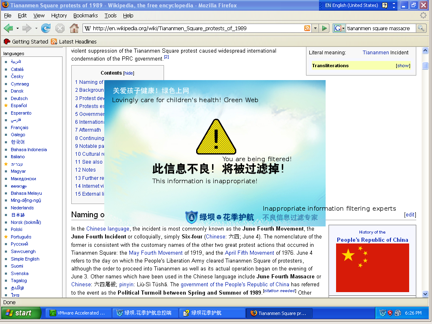
Except the IP-blocking and keywords-filtering, Chinese government is also seeking strengthen content-control, though failed once. In 2009, “Green Dam Youth Escort”, the software intend to restrict online pornography, has planned to pre-install for all new personal computers after July, 2009. However, it soon has been found that the software also filtering some politically sensitive contents like Tiananmen Square protests of 1989. Additionally, the core function of Green Dam is claimed of defective. The software is capable of recognizing featuring yellow-skinned pictures but cannot distinct the details that it censors the image of Garfield, a famous yellow Anime cat. In June 2009, the Green Dam Youth Escort would not be compulsory pre-installed anymore.

Green Dam's filtering/><br><br><span style=
Green Dam's filtering


Another kind of blocking is creating obstacle in reality, which not exactly equal to the technical methods what we have talked before. For example, The China Education and Research Network (CERNET), is providing internet services to universities. Visiting website inside CERNET is far faster than average internet speed in China. Fee of CERNET account provided to students was 5 RMB/month in Peking University, 2005, far cheaper than the price from common internet service provider, which was more than 100RMB/month. However, the normal student account of CERNET is only providing domestic internet services. To connect to international WWW, student needs to pay additional fee which is 90 RMB/month in Peking University. Though cheaper than the common fee, it is still too expensive to university student because of no-income. Many students try to across through the national boundary in internet by using free proxy server or pay for Virtual Private Network (VPN) that can avoid the expensive fee, despite according to the announcement in August 2011 from TAOBAO, the biggest online shopping website in China, VPN have become illegal commodities. In other words, the expensive international-internet services fee actually becomes a form that tackling university students to using internet freely.

3. Content-filtering
According to Zittrain&Edelman(2003), most sexually explicit content can easily passed the censorship. Only 101 pages (13.4%) were blocked among the test in 2011 that searched 752 pages including criteria “free adult sex” on Google. Although one purpose of the censorship is blocking sexual contents, it actually did not work very well, or the blocking of censorship system actually was not concentrating on the sexual field. Other words related to politics, such as Tibet, Taiwan, was very hard to access. The proportion of blocked sites among top 100 results from Google is 64% of Tibet, and 47% of Taiwan. But the result from 2001 cannot reflect the situation of internet censorship system in China nowadays, as the conclusion said “Whoever maintains the block lists is actively updating them, giving special attention to certain general-interest high profile sites where content changes frequently.” (Zittrain&Edelman 2003).

4. The effect
“It’s the Chinese leadership itself that is digging the Communist Party’s grave, by giving the Chinese people broadband” (Kristof 2005), commented by New York Times in 2005. However, we have not seen the internet caused many political changes. Because of effective politically regulation, internet users in China are mainly looking for entertainment online like games, chatting, streaming-videos, etc. What users seek out often is not political information because they know it is hard to find any political secret, and cannot change anything in reality even user found something on internet since the political system in China. The internet regulation in China is killing any other possibility of Chinese politics. A survey in five major Chinese cities in 2005 appeared that more than 90% people never or seldom use the proxy server to circumvent the blocking (MacKinnon 2008), which means most of internet users in China barely reach any information outside information. It makes Chinese cannot imagine the possibility of a democracy China. Despite many people complain about the political system in China, they cannot organized each other to make a systematic plan for democracy change because lacking necessary information and discussion which is regulated, especially after Chinese government updated the regulation of news, chat rooms and blogs in 2005. Meanwhile, lacking of the political opinion from China mainland user is leading to the condition that people from other countries may have misunderstanding about China by much promotion of anti-CCP.
On the other hand, the diatribes against Japan are acquiesced. It finally led to an offline protest activity which absolutely cannot happen if its purpose is democracy in China. The government is using the regulation to lead people to some “proper” topic they should discuss. In recent years, more discussion about problems of social and local government is allowed. However, behind the discussion, “50 Cent Party”, internet commentators hired by government who attempt to advocate CCP policies or government, are acting as they are unofficial users.

50 cent party
Commentators

All these regulations are confusing people; they do not know which contents are prepared for them by government. Government try to use the regulation as a tool leading to the result that people are losing trust to their internet.


Reference

Rebecca MacKinnon (2008). Flatter world and thicker walls? Blogs, censorship and civic discourse in China. Public Choice 134, 31–46. DOI 10.1007/s11127-007-9199-0.

Jonathan Zittrain, Benjamin Edelman (2003). Internet Filtering in China. IEEE Internet Computing, 7, no.2, 70-77, Mar./Apr.2003. DOI:10.1109/MIC.2003.1189191

Nicholas D. Kristof. (2005). Death by a thousand blogs. The New York Times, May 24, 2005. Retrieved Dec 21, 2011 from http://www.nytimes.com/2005/05/24/opinion/24kristoff.html

Monday, November 21, 2011

TCP/IP

Introduction

Most users of the internet see it only as a series of web pages, one intertwined with the next. However few realize the complex structure which lies beneath the web. Despite being a vast network of interconnected sub networks subsequently comprising of miles of wires and millions of switches, routers and servers, there lies hundreds of internationally recognized standards. This framework of standards allows computers and networks to communicate seamlessly with one another and across great distances with reliability. The Internet Protocol Suite, a group of standards created in the 1980s is the foundation for other web standards. It serves as the juncture point for technologies of different levels to communicate.


OSI Model

To understand the basic framework for all computer networking regardless of scope (Internet vs. Local Area Network) requires an understanding of the Open Systems Interconnection model described by the International Organization for Standardization.
The chart above describes a correspondence between two hosts, or computers across a network. Data transferred between hosts travel through different layers, some theoretical, some software, others in pure hardware. A request through this system proceeds down the stack of the sender, across to the receiver, then up the receiver stack until it reaches its destination layer. The dashed arrows in the diagram show that higher layers can talk to one another, but only if they traverse through lower layers in the stack. For example, if the transport layer of host 1 wishes to communicate to host 2 it must first communicate to the adjacent network layer, which subsequently communicates to the adjacent data link layer, through the adjacent physical layers and so-on.

Layers can only communicate with ones it is adjacent to (through an interface). A common example illustrating this concept could be a web browser on your computer. Web browsers operate regardless of the network interface card you have installed on your computer. Since a web browser communicates through other layers which interface with the network card, it does not need to have an understanding of every type of network interface (which exist in the link and physical layers) but only layers with which it directly interacts. This same concept exists with the Internet Protocol Suite. Software for TCP / IP has been developed for almost every computer platform that exists. However, it contains the same basic framework that allows all computers to communicate with one another. Here are short descriptions on how each layer contributes to the OSI Model:

Physical Layer: This layer describes the actual physical hardware that devices use to interconnect. Standards of voltage, bits and cable types are defined here.

Data Link Layer: This layer groups bits together into what are commonly called frames. These frames contain arbitrary data provided by higher levels in the hierarchy. The Data Link Layer provides mechanisms to prevent transmission errors and implement flow control.

Network Layer: The Network Layer provides a routing standard for networks to communicate with one another. This is where the Internet Protocol (the core protocol in the Internet Protocol Suite) resides in the OSI Model. The network layer is present in high-level networking devices such as hosts and routers, but not in others such as basic switches and networking hubs.

Transport Layer: This layer is in charge of making sure data from higher layers are transferred, not only without error, but will guarantee retransmission upon failure. Protocols in this layer such as the Transmission Control Protocol (TCP) and the User Datagram Protocol (UDP) send data packets and wait for a response from the remote host. Some protocols are sophisticated enough to resend lost packets and correct certain errors with little or no delay.

Session and Presentation Layers: The session layer allows higher layers to create a seamless transfer of data between hosts when a larger view of data transport is necessary. The presentation layer is used to translate machine-independent data received into machine-dependent data for the application layer to interpret. This could be due to differences in character encoding, the decryption of encrypted data or the decompression of compressed data.

Application Layer: This is the layer which most users directly interact with. Machine-dependent applications run at this layer which presents the network to the end user. In a common example on the World Wide Web, the client uses a web browser to send a request to a server. The web browser on the client machine runs in the application layer. The corresponding application on the server side is a web server running software to decode the WWW request and send a response.

Internet Protocol Suite

While these layers may seem to provide a great framework for network communication, they are useless without hardware and software. For the purpose of explaining the Internet Protocol (IP) suite, the layers will be combined into four simple groups as shown in the illustration below:

The IP Suite is comprised of software and hardware applications that run in the Application, Transport, Internet and Link layers. The majority of software for the IP Suite resides in the top three layers and will therefore be the focus of this post. As you may have guessed, the Internet Protocol exists in the Internet Layer. This is the protocol with which all data communicating over a network must traverse. It describes basic intercommunication between hosts including the definition of Internet Protocol addresses and subnets (the grouping of addresses together). The figure below illustrates the flow of data through the Internet Protocol:

Internet Protocol

The Internet Protocol (IP) was developed in 1974 by Vint Cerf and Bob Kahn and described in a paper titled “A Protocol for Packet Network Interaction”. At the time ARPANET, a predecessor to the modern-day Internet was in use and utilized a packet switched network. While ARPANET had only a handful of hosts participating in the network, the Internet Protocol allowed for seemingly infinite hosts which all could reside on the same network and described by different addresses. The most popular version of the Internet Protocol is IPv4. This version uses 32bit addressing commonly displayed in for octets of 8 bits each separated by dots (e.g. 192.168.1.0). In the past ten years the space of available addresses on the Internet has been becoming smaller thereby reducing the number of uniquely identifiable hosts that could be on the internet. IPv6, a new standard for the Internet Protocol is slowly being phased in. This version institutes a 128 bit addressing standard. Instead of the 4.29 x 10^9 addresses available in IPv4, there are 3.4 x 10^38 addresses available in the IPv6 standard. This increase in addresses not only allows for more unique hosts on the internet but also can increase traffic flow due to more efficient routing plans and the elimination of Network Address Translation (NAT) which had been previously implemented to expand the IPv4 space as much as possible. Below is a diagram explaining the various bits contained within each IP header attached to every data packet that flows through the IP layer:
Transmission Control Protocol

The Transmission Control Protocol (TCP) was created in conjunction with IP (thereby being referred to as TCP/IP). TCP is one of the protocols that live in the Transport Layer of both the OSI Model and the Internet Protocol Suite model. TCP is considered a “reliable protocol” which means that its purpose is to verify the receipt of data from host to host. When TCP sends data over IP it waits for an acknowledgement from the remote server. If one is not received it retransmits the data. This can be compared to the User Datagram Protocol (UDP), another core module of the IP Suite, in which no reliability is implemented. Below is a sample transmission of TCP in which a handshake is used to initiate a session:

In TCP data is sent with the expectation of an acknowledgement (ACK) being sent in return, potentially with other data. Duplex (two-way) conversations can happen simultaneously over one TCP session by sending ACKs in the same packet as other data. Many popular services that are used every day rely on TCP. Web browsing, email and the transfer of files over FTP use TCP.

TCP vs. UDP

The main difference between protocols such as TCP and UDP rely in the idea that TCP is a reliable protocol which institutes some delay (especially if there is packet loss) whereas UDP is an unreliable protocol which is simpler and faster. Each serves a specific purpose and the improper use of one or the other could prove catastrophic. Say, for example, you wished to transfer a file from a server to your local machine. If the transfer software utilized UDP, the unreliable protocol, any packets that were lost in the transfer due to network congestion or hardware issues would be lost and not part of your final download. These pieces would be lost and therefore you would not have a complete file. The server would not retransmit these lost packets because UDP does not listen for ACKs. TCP would be the more appropriate choice in this scenario.

On the contrary say you were streaming video and the network was relatively congested. UDP would be the more appropriate choice here because a few lost packets would not detract much from the overall video. You are more concerned with speed and update rate. Any lost data will be already in the past and unnecessary.

Conclusion

The Internet has grown much over the past 20 years. Much of that growth can be attributed to the development of standards such as TCP/IP. The creation of this framework has allowed for an internet that is unbounded by platform or proprietary technology. Although many people, myself included, may sometimes view the internet as what is presented by the World Wide Web, it is important to remember the complicated framework that lies beneath and permits the communication with which we sometimes take for granted.

Works Cited
Barr, Michael. "TCP/IP and UDP/IP for Embedded Systems | Embedded Systems Experts." Embedded Systems Experts. Netrino LLC, 12 Mar. 2007. Web. 22 Nov. 2011. http://www.netrino.com/Embedded-Systems/How-To/Embedded-TCP-IP.
"Defenses Against TCP SYN Flooding Attacks." The Internet Protocol Journal 9.4. Cisco Systems, Inc. Cisco Systems. Web. 22 Nov. 2011. http://www.cisco.com/web/about/ac123/ac147/archived_issues/ipj_9-4/syn_flooding_attacks.html.
Jessup, Troy. "Network Protocol Headers." Troy Jessup - Network Security Professional. Troy Jessup, Aug. 2010. Web. 22 Nov. 2011. http://www.troyjessup.com/headers/.
Leon-Garcia, Alberto, and Indra Widjaja. Communication Networks: Fundamental Concepts and Key Architectures. 2nd ed. New York: McGraw-Hill, 2004. Print.
"Open Systems Interconnection Reference Model." Hill2dot0. 21 Oct. 2008. Web. 22 Nov. 2011. http://wiki.hill.com/wiki/index.php?title=OSI_reference_model.
Steenkiste, Peter. "Layered Architecture." 18-345: Introduction to Telecommunication Networks. Pittsburgh. Spring 2011. Lecture.

Flash Sale Websites


FLASH SALES ON THE WEB

Flash sales have been around the retail world for a long time. They are typically 1-3 day sales, where products are priced up to 80% off. Classically they are located in a store or a venue that specializes in flash sales. With the excitement for ecommerce and the recent recession, on-line flash sales have emerged. These sites usually offer a sale for 24 to 36 hours and require their shoppers to be members. They send out notifications of their latest sales via email or social networking sites. Groupon shaped the business model for deal of the day sites, servicing over 500 cities worldwide and worth over $6 billion[1].

The first private sale company that was create was found in 2001 by Jacques-Antoine Granjon. He was a French entrepreneur and created a company called Vente-privee.com, this website hosted private sales of designer brands that ranged from fashion, accessories, home, electronics and wine [2].

In 2004, the site thewoot.com was launched, this site used the same concept as Vente-privee.com but was much more popular. By the end of 2006, over 100 flash sale sites emerged, the industry had exploded. In 2008, Groupon was launched, it became the second fastest company to be valued at $1 billion[3].

Business Model

These websites benefit both the business and the consumer. They benefit the consumer because they allow them to get products or opportunities for cheaper than the actual price, this is important now that the US is experiencing a recession. These websites are very easy to shop on and convenient to use. Flash sale websites benefit the businesses that participate because they get exposure of their products and can reach a large number of customers in a small period of time. After one daily deal, a business's exposure can increase up to 140% in a six month period [4]. After participating in a flash sale, businesses hope to improve long term by gaining repeat customers and marketing in a nontraditional way.

Fashion Flash Sale

Fashion flash sale websites are in the spotlight today, CNN Money made a rank of the "5 leading edge flash sale websites". The first on this list was ideeli.com, this is because it is the fastest growing of all the flash sale websites. When it was first launched in December 2007, Ideeli had tripled its members in less than a year. The second on this list was Gilt Groupe, gilt.com set the standards for fashion flash sale websites. Gilt Groupe was launched in November 2007 and is an invitation only website that sells high end/ luxury goods. It is the first fashion flash sale website to be valued at $1 billion.

Haute Look is the next on this list, launched in December 2007, hautelook.com has over 5 million members in the US and Canada. They were recently bought by Nordstrom, and have over 250 employees. Ruelala.com was launched more recently (2008), currently they have 300 employees and 4 million members. The fifth on this list is MyHabit.com, this website is Amazon's version of a flash sale site. This website was only launched 6 months ago, although it's more luxurious version of Amazon.com. [5]

Travel Flash Sale

There is a huge trend in adding a lifestyle section into these flash sale sites. Last May, Ideeli has partnered with the world's biggest online travel sale site, Voyage Prive.

More than 25 flash sale vacation sites have arose since the recent popularity of Groupon. They work by offering a limited amount of rooms for a few hotels worldwide, this deal usually lasts for about a week and customers usually save 50-60%. They are non-refundable or transferable but are usually much better than the deals offered by Expedia, Orbitz and Travelocity. Although, Expedia offers a daily flash sale for two hotels. Similar to fashion flash sale websites, most travel sites are membership only(membership is free) and cater to more expensive/luxurious hotels. Newly launched sites, such as Overstock's vacations, Trippo and Youpon sell more affordable rooms. Some travel sites, such as TripAlertz are a cross between flash sale sites and Groupon, the more people who book, the lower the price gets. The biggest problem with these websites is that they require advance payment and can't be changed or canceled. They also don't offer airfare, so buyers should always check the price and availability of transportation before booking. Advice when booking on these sites is to read the fine print and compare rates on other sites before buying [6].

Groupon

The most popular flash sale website is Groupon. The name blends the words "group" and "coupon" and was founded by Andrew Mason in 2008. The first deal on Groupon was half off pizzas on the first floor of its building in Chicago. Today, Groupon works with over 150 cities in North America and 100 cities in Europe, Asia and South America and has over 35 million registered users [7]. The website works by offering one "group coupon" a day for each city. The coupon is only available if a certain number of people sign up. If the minimum amount of customers is not met, no one gets the deal or coupon. For example Groupon could sell a $60 haircut for $30. Then Groupon and the company will split the earnings leaving the hairdresser with only $15. Groupon offers a different form of publicity. Unlike traditional forms of advertising, Groupon, doesn't require the business to pay upfront. Groupon refuses to work with controversial businesses such as abortion clinics, shooting ranges and strip clubs [8]. Groupon's customers are mostly female (62% on Groupon and 67% on Living Social are women), therefore the website typically offers deals for health fitness and beauty [9]. Groupon now offers a mobile application that allows its customers to purchase deals then use the screens of their phones as a coupon. They created another application for mobile and tablet users. This application consists of 2 buttons, "I'm hungry" and "I'm bored". This app locates (via GPS) the closest deals for food and entertainment. A problem with Groupon is that sometimes small businesses cannot handle the drastic increase in customers. This runs the risk that there won't be enough products or the customers would be left dissatisfied. It is also difficult for a business to even appear on Groupon because 1 in 8 companies are accepted [7]. A study at Rice University suggests that there are two factors that can make a Groupon promotion profitable in the future. The first is how well the employees are prepared for the promotion.
The second is the likelihood of new customers using the service. The most successful business on Groupon are Spas, 82% of customers who purchase the original deal on Groupon return to the spa again. Although, Restaurants are the least profitable. 42% report that the customers who used a Groupon expected special treatment, did not spend more than the coupon, did not tip and did not return to the restaurant. [9]

Groupon's only serious competitor is Livingsocial.com. This site became popular December 2010, after it received an investment from Amazon of $175 million. Livingsocial is very similar to Groupon because they both have daily deals. Although, living social offers special deals on adventures, such as hikes, hang gliding and kayaking, and deals on escapes, vacations. [10]

Overall, flash sale websites have arose during troubled times and furthered the growth and development of ecommerce. They offer a more simplified and cheaper way to shop. These websites make opportunities affordable and available, therefore making them very popular and valuable.

[1] Kincaid, Jason (2011 [last update]). "Confirmed: The Groupon/Google Deal Is Off". techcrunch.com. Retrieved November 10, 2011.

[2] Blodget, Henry. " Flash-Sale Leader Gilt Groupe Raising $80-$100 Million At A ~$1 Billion Valuation" . Business Insider, February 21, 2011 retrieved October 2, 2011

[3] Steiner, Christopher. “Meet The Fastest Growing Company Ever”, Forbes Magazine, August 30, 2010, retrieved October 1, 2011

[4] Dholakia, Utpal M.; Tsabar, Gur (1 May 2011). "A Startup’s Experience with Running a Groupon Promotion". Social Science Research Network, Working Paper Series. Retrieved November 10,2011.

[5] Khalid, Kiran. "5 Leading-edge Flash Sale Sites." CNNMoney - Business, Financial and Personal Finance News. CNN Money, 27 May 2011. Web. 15 Nov. 2011. .

[6] Bly, Laura. "USATODAY.com." Travel News & Guide: USA TODAY Travel Network - USATODAY.com. USA Today, 29 Apr. 2011. Web. 20 Nov. 2011. .

[7] Weiss, Bari. "The Weekend Interview with Andrew Mason: Groupon's $6 Billion Gambler - WSJ.com." Business News & Financial News - The Wall Street Journal - Wsj.com. The Wall Street Journal, 20 Dec. 2010. Web. 20 Nov. 2011. .

[8] Williams, Geoff. "Groupon's Andrew Mason: The Unlikely Dealmaker - AOL Small Business." Small Business - News, Advice and Ideas at AOL Small Business - AOL Small Business. AOL Small Business, 9 Aug. 2010. Web. 21 Nov. 2011. .

[9] Dunham, Jamie. "Marketing to Women: Groupon or Groupoff? 10 Facts You Need To Know « The Lipstick Economy." The Lipstick Economy. Wordpress, 8 Oct. 2010. Web. 21 Nov. 2011. .

[10] Dugan, Lauren. "LivingSocial Brings Urban Adventures to Its 10 Million Members - SocialTimes.com." SocialTimes.com - Your Social Media Source. 9 Oct. 2010. Web. 21 Nov. 2011. .

Organized crime on the Internet

One of the greatest threats of the Internet is the security breaches that can cause damage to individuals, companies, governments, and organizations. Since the advent of the World Wide Web, some have taken an interest in abusing and exploiting loopholes in the system. More commonly known as hackers, these people have the knowledge to develop malicious programs, write viruses, deface websites, steal data, and much more. Their actions can be traced to different motives, ranging from pure mischief, intended damage such as theft, to organized crime. As the complexity of security attacks increased over time, so did the seriousness of their motives. A single individual may no longer be the sole person behind a website defacement incident. Instead, groups of political activists or terrorists could be the ones responsible in today’s world.

FORMS OF CYBERCRIME

1. Script Kiddies

Script kiddies are usually individuals or a group of casual juvenile hackers. They utilize tools and scripts written by expert black-hat programmers to launch attacks over the Internet. In most cases, they do not have the technical proficiency to develop sophisticated exploits, but rely on powerful programs that can be obtained over the Internet. However, armed with just the knowledge on how to operate these programs, script kiddies still can cause potentially damaging effects. They do not usually have a clear motive, other than seeking thrill and prestige. One of the most well-known examples of a script kiddie is Mafiaboy, a high school student from Canada who performed denial-of-service attacks on Yahoo, Dell, eBay and CNN. The financial loss was estimated to be $1.2billion globally.

2. Fraud, Scams, and identity theft

Most of us have probably been targets of online fraud or email scams before. Nigerian scams, Eastern European scams or the Work-At-Home schemes are the common examples we often see. They come in the form of spam email, online banner ads, or malicious hyperlinks. These activities are usually organized and carefully planned. The perpetuators make use of people’s greed of getting rich overnight and bank on their foolishness to participate in the scam. A small payment is usually requested upfront as a starting fee, but bigger payments are demanded later on to ‘unlock’ administrative requirements or to reap higher investment returns. When the victim finally realizes that he or she will not be getting any real benefits, the perpetuators of the scheme will disappear along with the invested cash.

Another form of scam is identity theft. Identity theft occurs when online thieves manage to obtain confidential and private information of people such addresses, Social Security Number, or credit card and bank details. The victim can be tricked into revealing the information via phishing scams – whereby the perpetuator uses an email spoof to ask for the victim’s user name and password. Another method is to use a cross-site scripting attack to redirect the user from a legitimate website to a fake one. Hackers can set up seemingly real replicas of banking sites and an unsuspecting user will enter his login credentials without a clue of what is happening. The perpetuator then uses the information to make purchases, transfer funds, or impersonate the person online. Usually, victims do not realize that their confidential data are stolen until it is too late.

To recognize legitimate websites and learn tips on how to shop safely online, do visit this link: http://www.pcmag.com/article2/0,2817,2373130,00.asp

3. Hactivism

The next form of cybercrime takes the form of both activism and hacking. Hactivists usually have a political motivation or an agenda that they are campaigning for. They often operate in groups and work aggressively to attack the web server or websites of organizations that they are fighting against. Hactivists aim for high-profile operations to generate as much publicity as possible, in hope of garnering support from the public and put pressure on policy makers. This form of activism is fast gaining popularity in recent years, and infamous groups like Anonymous and Lulzsec have been making headlines in the IT world with their large scale and successful attacks on multinational corporations, multiple governments, agencies such as CIA, FBI - the list goes on.
The strength of hactivists is that they can harness the power of non-technical savvy people that are willing to participate in their cause. They develop special software that can be downloaded and it allows anyone to ‘lend’ their computers as part of the operation. This effect is potentially destructive as virtually no website can withstand a huge amount of data overload from different sources. Also, these cybercriminals utilize many forms of techniques in their operations. The four most common types are:

  • Virtual sit-ins: Activists visit a website repetitively together at the same time to generate so much traffic such that other users cannot reach it. In 1998, the hacker group Electronic Disturbance Theater (EDT) set up special sites with automated software that participants could visit and download. An estimated 10,000 activists engaged in the operation, causing floods to the sites of the Pentagon and the Frankfurt Stock Exchange.
  • Automated Email Bombs: Email bombs are massive amount of emails, usually with large attachments, sent to government policy makers. This will jam their mailboxes and prevent them from receiving their usual day-to-day work emails.
  • Web hacks and break-ins: This form of attack is a large category of many other methods. Essentially, it involves the intrusion into the server of the victimized website and performing malicious acts such as defacement, redirecting visitors to another site, or exposing user data and information.
  • Viruses and Worms: Hactivists can also utilize viruses and worms to propagate their message and damage targeted computer systems. In 1989, the Wank worm developed by anti-nuclear hackers infiltrated into NASA’s network. Scientists logging into computers on that morning were greeted with the message above.

4. Cyberterrorism and Cyberwarfare

The last category of organized crime is on the largest scale – possibly involving entire nations or terrorist groups. In April 2009, US officials reported that electricity grids could have been compromised by hackers, who had hidden software code that can potentially disrupt power supplies. A senior intelligence official told the Wall Street Journal that "The Chinese have attempted to map our infrastructure, such as the electrical grid, "So have the Russians." Although the attacks originated from China and Russia, both countries denied any government involvement in the matter. As such, it is unclear whether any terrorist groups had a hand in it or it was a politically motivated attack.

RECENT EVENTS

Recent events in late 2010 and the first half of 2011 brought the IT world to a jolt. It was a wake-up call for security professionals and government agencies when two hacker groups – Anonymous and Lulzsec, started a barrage of operations against numerous organizations. When Wikileaks came under pressure to close down, Anonymous launched attacks against Amazon, PayPal, MasterCard, Visa for their refusal to process transactions for Wikileaks donations. Many government websites were also targeted, such as Zimbabwe and Malaysia, for blocking accessing to Wikileaks.

As an international hacking group, Anonymous comprises of members which maintains their anonymity to each other. It is not led by any visible leader but has been described as “users simultaneously existing as an anarchic, chaotic, global brain.” The group runs many hacking operations, often with the help of willing individuals that have downloaded a software called Low Orbit Ion Cannon, which contributes their personal computer to a bot network. This army of computer bots is then used by Anonymous to launch massive Distributed Denial of Service (DDos) attacks.

Anonymous had also teamed up with Lulzsec, declaring war on all governments and big corporations. Read more about their statement here: http://gizmodo.com/5813560/lulzsec-and-anonymous-declare-open-war-against-all-governments-and-fat-cats

Lulzsec was a team of six people and possibly members of part of the larger Anonymous group. Formed in early 2011, the group made its debut by compromising the web server of Sony Pictures and posting 150,000 people’s passwords, names, addresses and emails online. Lulzsec has also broken into the US Senate’s website, stole information from the Department of Homeland Security, Arizona Department of Public Safety and published their sensitive information on the Internet. High-profile organizations such as the IMF and defense contractor Lockheed Martin were also not spared. The group has also claimed credit for a DDoS attack that took down CIA’s official website, www.cia.gov. Many have said that Lulzsec operations has brought hacktivism to a whole new level. They challenged authorities upfront, gave pre-warnings to companies before their impending attacks (while still succeeding), and made use of social media such as Twitter. This allowed them to achieve a remarkable marketing effect with the public media. By the time Lulzsec called it quits at the end of June 2011, their twitter profile had 283,000 followers. (http://twitter.com/#!/LulzSec)

THOUGHTS AND CONCLUSION

The above events have shown that organized crime on the Internet are becoming more borderless and transnational. Many people from different countries can participate in the same ‘hacking operation’ without knowing the true names behind their online identities. The rate at which cyber attacks are evolving is becoming an alarming situation which warrants strong and concrete defensive action. Law enforcement agencies are sometimes rendered helpless in dealing with these criminals. It costs too much time and effort to procure enough evidence to nail the hackers, and another issue is that the most talented people are usually at the dark side of the fight. This issue is so pressing that FBI had to issue a call for hackers’ help at an annual Black Hat security conference. (http://news.cnet.com/FBI-calls-for-hacker-help/2100-7348_3-6101475.html?tag=lia;rcol)

Governments and security agencies around the world have to step up their efforts and understand that the Internet has already become a war field. We are no longer living in an era where hackers merely deface websites for fun, or steal credit card information for their own petty gains. We are dealing with large-scale, coordinated attacks from powerful groups or even nations. They have motives and agendas that transcend personal gains, and no one is immune from these attacks. To be able to effectively counter all these, we must involve more than just security firms or rely on the government to tackle the problem. Companies should play a vital role and never compromise on the security of their own systems. No organization should view IT security as a cost center, but as an essential part of their businesses if they wish to safeguard their data and protect their customers and clients.

As for the everyday person, hacking news inthe headlines may seem interesting and fun to follow, but we should watch out too; for one may never know whether our own computers are being used as a part of the bot-armies for the hackers out there.


References

http://www.wired.com/science/discoveries/news/2007/02/72573

http://en.wikipedia.org/wiki/Script_kiddie

http://www.totse2.com/totse/en/technology/cyberspace_the_new_frontier/cyberspc.html

http://www.telegraph.co.uk/news/worldnews/asia/china/5126584/China-and-Russia-hack-into-US-power-grid.html

http://gizmodo.com/5815546/lulzsec-calls-it-quits

http://articles.nydailynews.com/2010-12-08/news/27083817_1_wikileaks-megrahi-lockerbie-bomber

http://www.pcmag.com/article2/0,2817,2387716,00.asp

http://www.cio.com/article/688260/Anonymous_Breaches_Another_US_Defense_Contractor