1. Introduction
Internet changed our lives. It seems as a symbol of “freedom” and “share” since likely everyone can connect to internet, publishes and gets any kind of information if he or she wants to, though not exactly true. Many people argue the internet as a kind of “freedom” is changing China. However, China government has its own way to control the internet in China by blocking some information. To check how free the internet it is in China, we have to answer the following questions: What has been blocked? How? And what is the effect?
2. Blocking: Censorship and other methods
For international connection, Domain Name Server IP Address Blocking is mainly used, which means the conversion the domain name of website into numerical IP, the address that can recognize by the server, is impossible. List of websites which has been IP-blocked is long: Facebook, Twitter, YouTube, BBC, etc. Large blog websites such as Blogger.com is also unavailable in China. The purpose of blocking these sites can be considered as to avoid visiting of politically sensitive contents, which may “disturbing the social order”. For example, many democracy-related videos which have been banned in China mainland are easily accessible in YouTube such as “Tiananmen”, the documentary of Tiananmen Square protests of 1989. Instead of these abroad sites, China has alternatively domestic sites that have the same functions. Some of these sites are even very similar to the original sites, like “RenRen” to “Facebook”. All these alternative sites are easier to manage because all the servers and capitals are based on China mainland, thus regulate by Chinese government.

Renren vs Facebook
For national connection, the keywords-filtering censorship is dominated. Main blog sites have the similar process to deal with the blog which may contains banned contents like “Falun gong”. Firstly, user is prevented from input any politically sensitive words by the blog posting system. An error message will be generated if user want to save the article contains sensitive words: “The contents you submitted have sensitive words, please check it again!” Moreover, the article submitted by user still need to check manually by administrator. The contents may also delete in 24-48 hours even it has already posted. Not only blog, the most popular live-chatting soft in China called “QQ” is also monitoring by a keywords-filtering system. The message includes any keyword on the blacklist, like “Jiangzemin”, the former leader’s name of China, will not be received in chatting nor mentioned with any error message. Search engines are also applied by the keywords-censorship. Searching sensitive words will return an error of “cannot found the page” or can get filtered result by a message “According to the policy and regulation of government, some search results were not shown”.
Except the IP-blocking and keywords-filtering, Chinese government is also seeking strengthen content-control, though failed once. In 2009, “Green Dam Youth Escort”, the software intend to restrict online pornography, has planned to pre-install for all new personal computers after July, 2009. However, it soon has been found that the software also filtering some politically sensitive contents like Tiananmen Square protests of 1989. Additionally, the core function of Green Dam is claimed of defective. The software is capable of recognizing featuring yellow-skinned pictures but cannot distinct the details that it censors the image of Garfield, a famous yellow Anime cat. In June 2009, the Green Dam Youth Escort would not be compulsory pre-installed anymore.
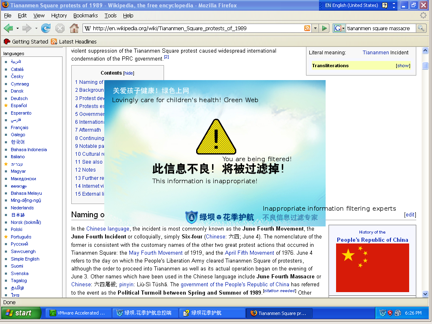
Green Dam's filtering
Another kind of blocking is creating obstacle in reality, which not exactly equal to the technical methods what we have talked before. For example, The China Education and Research Network (CERNET), is providing internet services to universities. Visiting website inside CERNET is far faster than average internet speed in China. Fee of CERNET account provided to students was 5 RMB/month in Peking University, 2005, far cheaper than the price from common internet service provider, which was more than 100RMB/month. However, the normal student account of CERNET is only providing domestic internet services. To connect to international WWW, student needs to pay additional fee which is 90 RMB/month in Peking University. Though cheaper than the common fee, it is still too expensive to university student because of no-income. Many students try to across through the national boundary in internet by using free proxy server or pay for Virtual Private Network (VPN) that can avoid the expensive fee, despite according to the announcement in August 2011 from TAOBAO, the biggest online shopping website in China, VPN have become illegal commodities. In other words, the expensive international-internet services fee actually becomes a form that tackling university students to using internet freely.
3. Content-filtering
According to Zittrain&Edelman(2003), most sexually explicit content can easily passed the censorship. Only 101 pages (13.4%) were blocked among the test in 2011 that searched 752 pages including criteria “free adult sex” on Google. Although one purpose of the censorship is blocking sexual contents, it actually did not work very well, or the blocking of censorship system actually was not concentrating on the sexual field. Other words related to politics, such as Tibet, Taiwan, was very hard to access. The proportion of blocked sites among top 100 results from Google is 64% of Tibet, and 47% of Taiwan. But the result from 2001 cannot reflect the situation of internet censorship system in China nowadays, as the conclusion said “Whoever maintains the block lists is actively updating them, giving special attention to certain general-interest high profile sites where content changes frequently.” (Zittrain&Edelman 2003).
4. The effect
“It’s the Chinese leadership itself that is digging the Communist Party’s grave, by giving the Chinese people broadband” (Kristof 2005), commented by New York Times in 2005. However, we have not seen the internet caused many political changes. Because of effective politically regulation, internet users in China are mainly looking for entertainment online like games, chatting, streaming-videos, etc. What users seek out often is not political information because they know it is hard to find any political secret, and cannot change anything in reality even user found something on internet since the political system in China. The internet regulation in China is killing any other possibility of Chinese politics. A survey in five major Chinese cities in 2005 appeared that more than 90% people never or seldom use the proxy server to circumvent the blocking (MacKinnon 2008), which means most of internet users in China barely reach any information outside information. It makes Chinese cannot imagine the possibility of a democracy China. Despite many people complain about the political system in China, they cannot organized each other to make a systematic plan for democracy change because lacking necessary information and discussion which is regulated, especially after Chinese government updated the regulation of news, chat rooms and blogs in 2005. Meanwhile, lacking of the political opinion from China mainland user is leading to the condition that people from other countries may have misunderstanding about China by much promotion of anti-CCP.
On the other hand, the diatribes against Japan are acquiesced. It finally led to an offline protest activity which absolutely cannot happen if its purpose is democracy in China. The government is using the regulation to lead people to some “proper” topic they should discuss. In recent years, more discussion about problems of social and local government is allowed. However, behind the discussion, “50 Cent Party”, internet commentators hired by government who attempt to advocate CCP policies or government, are acting as they are unofficial users.

Commentators
All these regulations are confusing people; they do not know which contents are prepared for them by government. Government try to use the regulation as a tool leading to the result that people are losing trust to their internet.
Reference
Rebecca MacKinnon (2008). Flatter world and thicker walls? Blogs, censorship and civic discourse in China. Public Choice 134, 31–46. DOI 10.1007/s11127-007-9199-0.
Jonathan Zittrain, Benjamin Edelman (2003). Internet Filtering in China. IEEE Internet Computing, 7, no.2, 70-77, Mar./Apr.2003. DOI:10.1109/MIC.2003.1189191
Nicholas D. Kristof. (2005). Death by a thousand blogs. The New York Times, May 24, 2005. Retrieved Dec 21, 2011 from http://www.nytimes.com/2005/05/24/opinion/24kristoff.html

No comments:
Post a Comment